The 40-yard container measures about 22 feet long, 8 feet wide, and 8 feet high, and its roughly 40-cubic-yard capacity equals about 16 pickup-truck loads. It is the right fit for high-volume jobs where bulk, not…
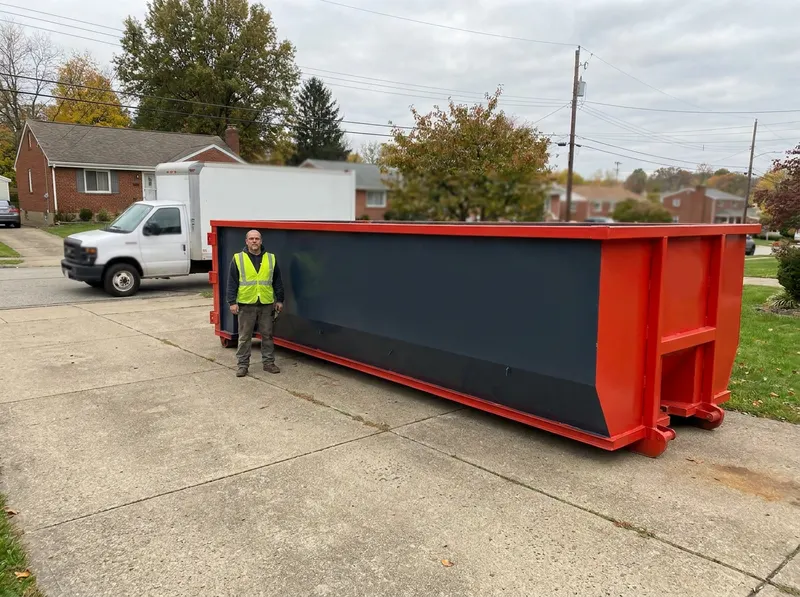
The 40-yard container measures about 22 feet long, 8 feet wide, and 8 feet high, and its roughly 40-cubic-yard capacity equals about 16 pickup-truck loads. It is the right fit for high-volume jobs where bulk, not weight, is the limiting factor: a whole-house gut renovation in Squirrel Hill, a multi-unit cleanout in Lawrenceville, commercial fit-outs along East Carson Street in South Side Flats, or a demolition that produces framing lumber, cabinetry, drywall, and light siding. For a single-room remodel a 10-yard is enough; for a roof tear-off a 20-yard or 30-yard usually wins because asphalt shingles are dense and hit the weight ceiling long before the box fills.
The trade-off on a 40-yard is footprint versus volume: it holds the most debris but needs the most room to set down and clear overhead.
Step 1: call (412) 332-0659 or text a job photo and confirm the 40-yard and a drop spot. Step 2: the container is delivered on the scheduled window, often same-day or next-day. Step 3: the box sits for the agreed rental period while the crew loads it from ground level.
Step 4: a call sets the pickup. Step 5: it is hauled to a licensed transfer station and the $895 covers the disposal. Because a 40-yard runs 22 feet and sits high, placement matters more here than on smaller sizes, a flat driveway, a contractor lot, or a cleared stretch of street works; the Pittsburgh Department of Public Works requires a permit when a container occupies a public street or blocks a right-of-way, and narrow one-way blocks in Polish Hill, Bloomfield, and parts of Mount Washington can rule out curb placement entirely.
Pittsburgh's hillside grades and tight older streets in Brookline, Greenfield, and Highland Park mean the delivery truck needs clearance and a reasonably level surface; a 40-yard loaded with concrete, dirt, or brick will exceed what the truck and the roads can legally carry, so dense material is better split into a smaller box with heavier allowances.
Keep the load level with the top rail, debris cannot ride above the sides for safe transport under federal motor-carrier load rules. A roll-off dumpster rental is not junk removal: the container is dropped and the customer or crew loads it, which keeps the construction and demolition debris cost down versus hauled-away service.
Prohibited items are consistent across the fleet: no wet paint, solvents, oils, or other household hazardous waste, no tires, no appliances containing refrigerant, no propane tanks or other compressed gas cylinders, and no electronics covered by Pennsylvania's Covered Device Recycling Act. Scrap metal and clean cardboard can often be diverted through local recycling drop-off, and the Pennsylvania DEP and Allegheny County set the disposal rules the transfer station follows.
Jobsite handling of a large container should follow OSHA construction safety practice, keep the load path clear and do not overfill.
Every job gets a firm, written price after an on-site visit.
Tell us about your 40-yard dumpster rental job in Pittsburgh and we'll send a clear, written quote, usually the same day.
 Iron Will Dumpster Rental